

Mastering the creative technique of two-chair work.
A CPD weekend with Michael Soth. Two days on what actually happens in the chairs, and the first step towards the full six-day course in May.
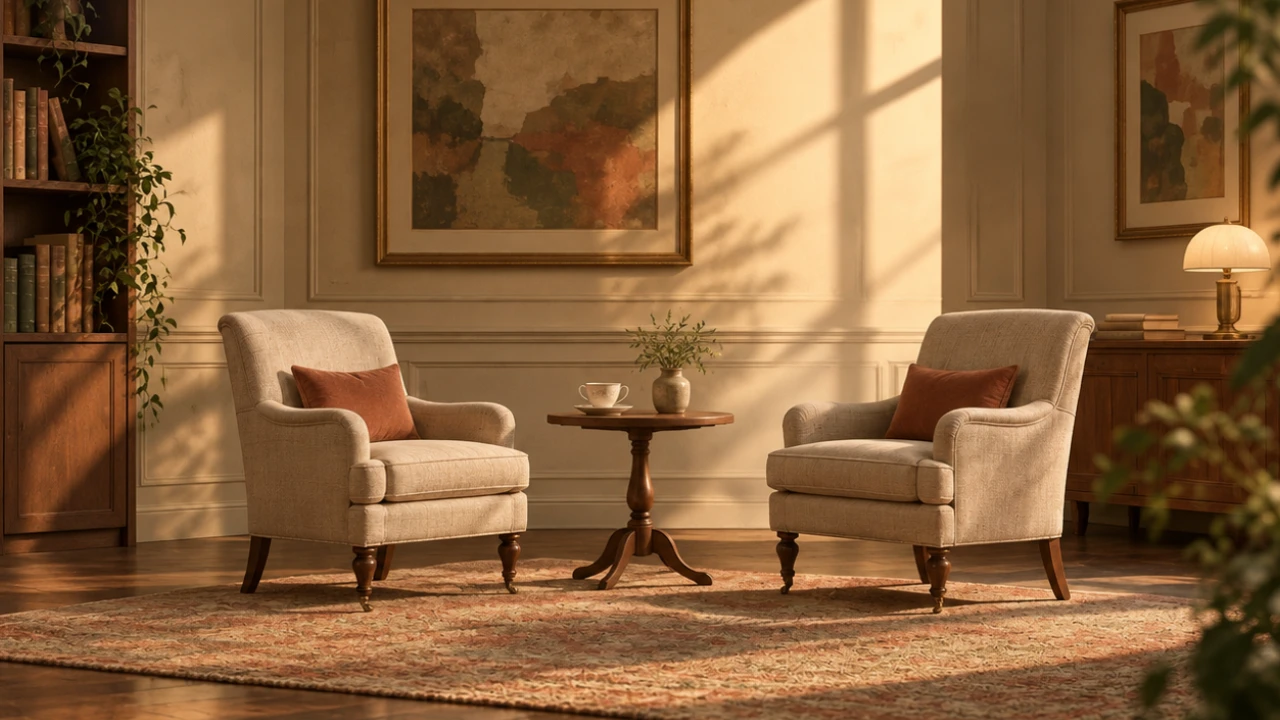
When two-chair work stops working.
Two-chair or empty-chair work can be one of the most powerful ways of moving therapy from talking about an experience to actively exploring and embodying it. But therapists who use the technique often meet a familiar problem.
An emotionally alive issue is identified. The chairs are set up. The dialogue begins. And then the energy disappears.
The client becomes self-conscious or feels they are “performing”. The dialogue turns repetitive and artificial, or goes round in circles. What felt alive and promising goes flat.
Rather than treating them as failures of the technique, Michael explores why these difficulties are inescapably inherent in two-chair work, how to recognise them as they arise, and how to use them creatively within the therapeutic process.
The micro-detail of what you actually do and say.
The weekend focuses on the micro-detail of therapeutic practice, and on the problems that recur most often:
- What the therapist actually does and says
- When and how to intervene
- How to introduce and set up the work
- How to keep the experiential, embodied focus without forcing an outcome
- How to recognise what is happening when the dialogue loses energy
- How to perceive the mixing or flipping of the polarities as a predictable probability
- How to respond to self-consciousness and performance anxiety
- How to notice and deal with the charge jumping out of the dialogue into the transference
- How timing and sequencing affect the process
- How to facilitate movement towards resolution
The aim is not a mechanical procedure or recipe, but to understand the technique’s inherent logic and underlying, paradoxical principles, so you can use it with greater confidence, flexibility and spontaneity.
Four stages, worked in sequence.
Perceiving the polarities
Recognising the positions, voices or relational configurations worth identifying, naming and bringing into dialogue.
Setting up the dialogue
Introducing chair work elegantly, so that it feels relevant and alive rather than artificial or imposed.
Directing the process
How much direction is useful, and what to do when the dialogue turns repetitive, intellectualised or flat, or when the polarities mix or flip.
Facilitating resolution
Supporting increasing awareness without imposing a “successful” outcome, including the possibility of a third position.
Reserve your place for 12–13 December.
Choose where you live to see your fee. Early-bird fees apply until 30 November 2026. Nothing is paid on this page. Right after you register, you receive an email with your fee, the payment details for your region and a reference number. Once you have paid, upload your proof of payment with the link in that email. Your registration is confirmed once it has been received.
Right after you register, you receive an email with the payment details. You can pay by:
- Bank transfer in pounds
- PayPal
- Revolut
Right after you register, you receive an email with the payment details. You can pay by:
- Bank transfer in euros
- PayPal
- Revolut
Right after you register, you receive an email with the payment details. You can pay by:
- PayPal
- Revolut
Right after you register, you receive an email with the payment details. You can pay by:
- Bank transfer in euros
- PayPal
- Revolut
Tell us your country below. Right after you register, you receive an email with the payment details. You can pay by:
- PayPal
- Revolut
- Bank transfer in pounds or euros
Take it further: six days, May to July 2027.
The December weekend is an introduction. The full course, Mastering the Creative Technique of Two-Chair Work, runs over three weekends (22–23 May, 19–20 Jun, 17–18 Jul 2027), with time to practise in between. Early-bird fees until 1 March 2027.
Michael Soth
Michael Soth is an integral-relational body psychotherapist, trainer, supervisor, mentor and group facilitator. He studied, lived and worked in the UK between 1982 and 2021, and was for decades Training Director at the Chiron Centre for Body Psychotherapy. He is co-editor of the Handbook of Body Psychotherapy and Somatic Psychology (2015). Since 2021 he has lived near the rainforest in Central America, where he works online.